
By John Rice | Margaret River Micro-Wedding Photographer and Complete Planner | Last updated October 2026
Planning a micro-wedding Margaret River for up to 20 guests is genuinely straightforward when you know the locations, the permit rules, and what a full day actually looks like.. The short version: you choose a ceremony spot (forest or beach), book an all-inclusive planner who handles every vendor and permit for a single payment, and show up. The long version is below, covering everything from costs to seasonal timing to what your guests do while you disappear into the karri trees for golden hour portraits.
This guide is written by John Rice, micro-wedding Margaret River photographer and complete planner, based on 300+ ceremonies planned and photographed across the South West.
What is the difference between an elopement and a micro-wedding in Australia?
The line matters, because the two formats call for entirely different planning.
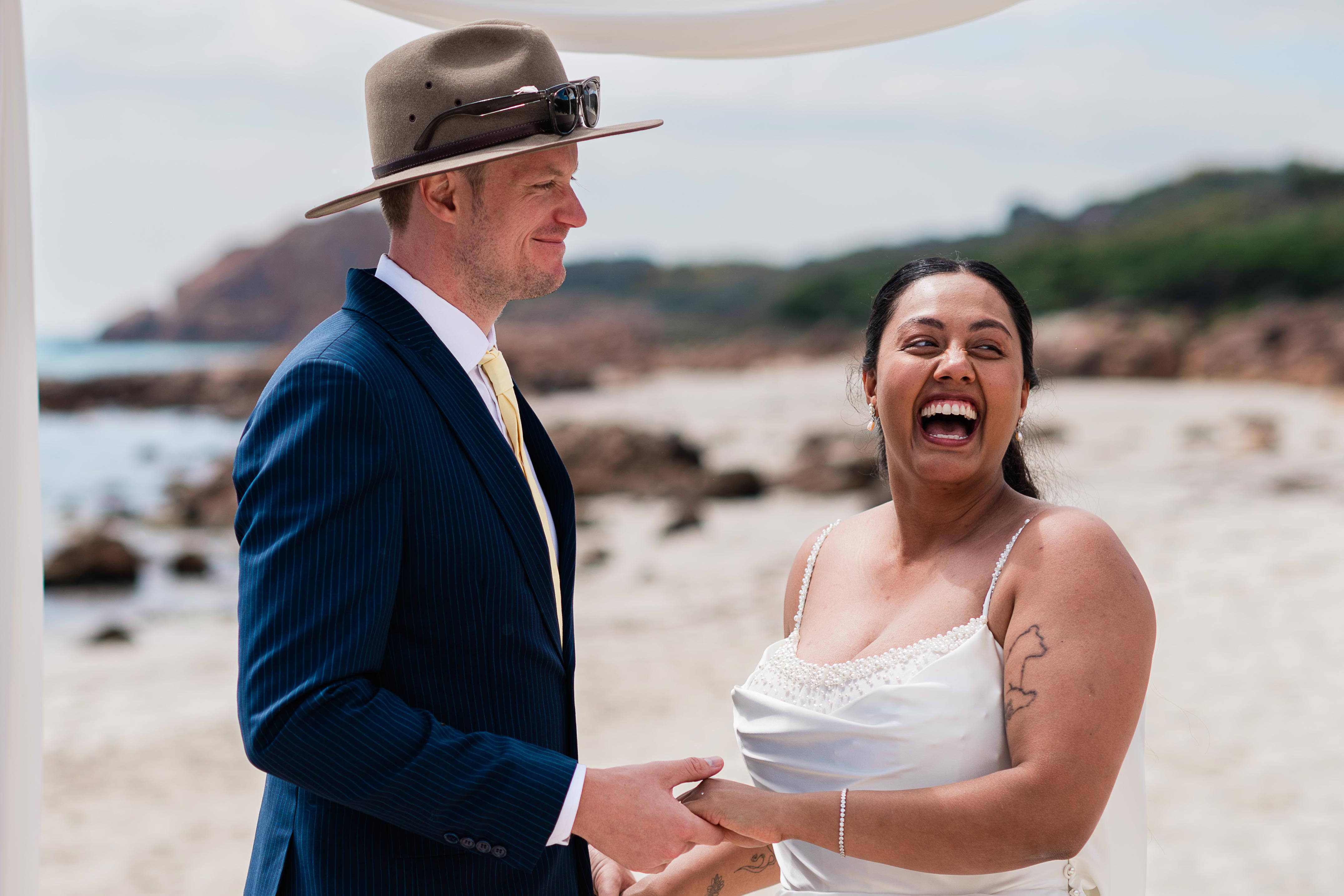
An elopement in Australia typically means 2 to 10 guests, usually just the couple plus immediate family or two witnesses. The ceremony is intimate, often spontaneous in feel, and the day revolves entirely around the couple. A micro-wedding sits between 10 and 30 guests.
It keeps the small-scale intention of an elopement but adds structure: a styled ceremony, formal photography, a group celebration afterward, often a shared meal. If your numbers are closer to just the two of you, my guide to eloping in Margaret River covers that smaller format in full.
Twenty guests is the sweet spot. Large enough to feel like a real celebration with the people who matter most. Small enough that you know every face in every photograph, that no one gets lost in a crowd, and that you actually get to speak to each person before the day is over.
The other practical difference is logistics. An elopement for two can be organised in weeks. A micro-wedding for 20 guests requires ceremony permits, vendor coordination across multiple suppliers, guest transport, a timeline, and a plan for what those 20 people are doing between the ceremony and dinner. That coordination is the job of a complete planner. It should not be yours.
Micro-wedding Margaret River cost: how much for 20 guests?
The honest answer is that it depends on what you include, but here is a concrete starting point.
| Package Level | Price Range (AUD) | What Is Typically Included |
|---|---|---|
| Core Dream Team (Saturday, 20 guests) | From $4,800 +GST | Photography, celebrant, florist, hair and makeup |
| Mid-Range All-Inclusive | $5,000 to $10,000 +GST | Full vendor coordination, transport, furniture & styling, picnic hamper, ceremony bar |
| Deluxe Full Experience | $6,990 to $18,000+GST | All of the above plus video, private chef dinner, content creator, premium florals |
For context, the average traditional Australian wedding in 2026 costs $38,252. Couples planning a micro-wedding are not cutting corners. They are choosing where to spend. Twenty guests means a higher quality spend per person, better food, a private chef instead of a venue kitchen, and a day that actually fits around the people you love rather than the other way around.
Permit fees are separate and add between $96 and $273 depending on location. More on that below.
What ceremony locations work best for 20 guests in Margaret River?
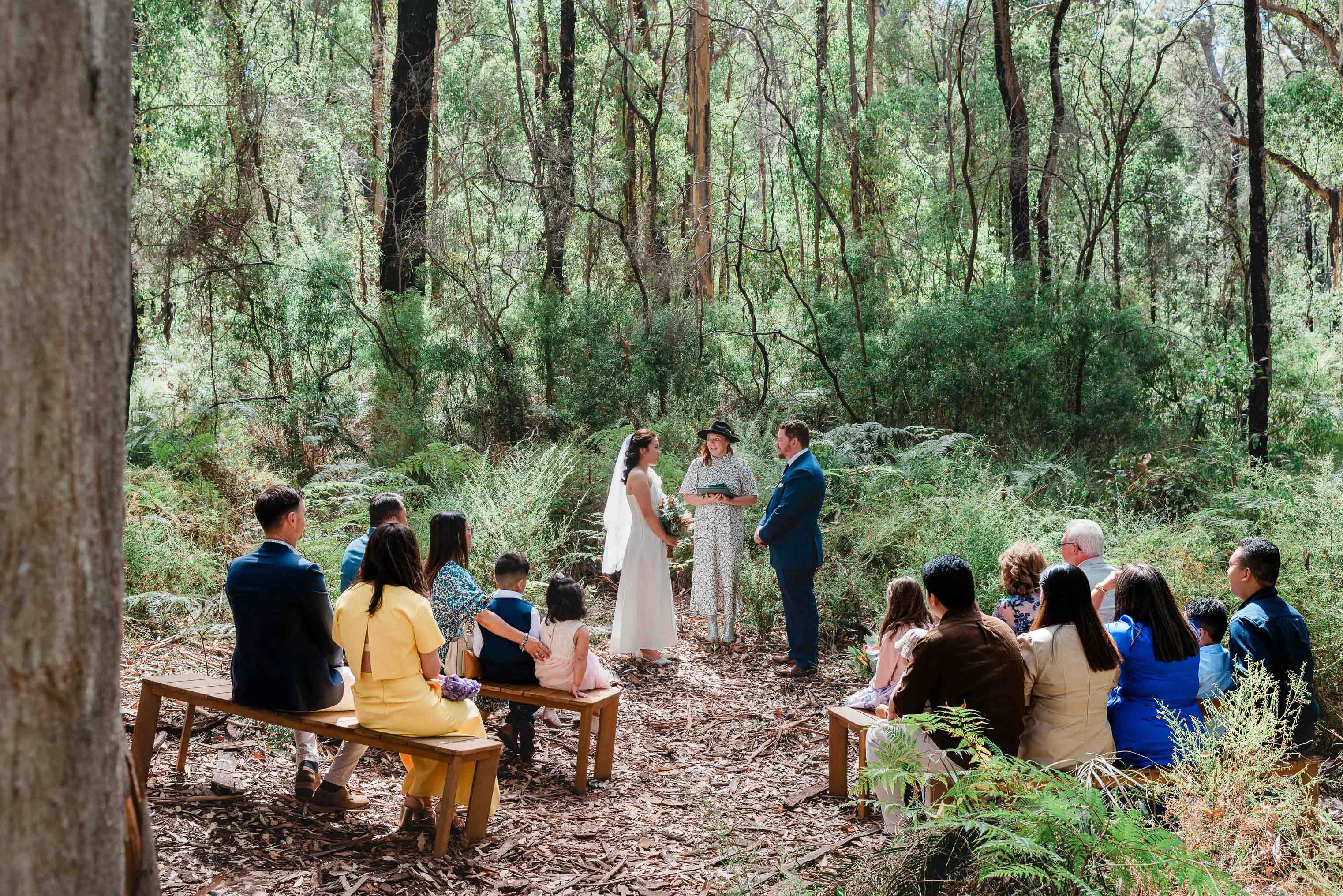
The South West offers two distinct environments for outdoor ceremonies: coastal and forest. Both are genuinely extraordinary. The choice comes down to light, wind, and what you want the photographs to feel like.
Boranup Forest is the most photographically dramatic option in the region. Ancient karri trees reach 50 metres overhead, filtering afternoon light into long diagonal shafts that land exactly where you want them. A ceremony in Boranup at 4pm in autumn looks like nothing else in Western Australia. Twenty guests standing among those trunks, no arch needed, no decoration required. The forest provides everything. The DBCA permit for Boranup costs nothing for the ceremony itself, though a commercial operator licence applies to all hired professionals.
Hamelin Bay is the coastal ceremony of choice for groups who want beach drama without the afternoon wind problem. Sheltered from the prevailing south-westerlies, it stays calm when Gnarabup is being sandblasted. The stingray population at the boat ramp is a legitimate talking point for guests. The permit is jointly managed by SAMR and DBCA.
Bunker Bay sits in the Busselton City jurisdiction, not the Shire of Augusta Margaret River. That matters because the permit rules are different, the fee is lower ($96 plus a $65 booking fee), and flower petals are allowed at the conclusion of the ceremony, which SAMR explicitly prohibits. North-facing, the bay stays sheltered through most of the afternoon.
Redgate Beach is Margaret River’s most photographed coastal location, offering clifftop rocks, sandy beach, and diverse backdrops within a short walk of each other. It sits under Shire of Augusta Margaret River jurisdiction, with a $156 permit fee and stricter confetti and structure rules than Busselton locations.
Sugarloaf Rock offers the most dramatic clifftop views in the region. No drones are permitted here. No structures either. The ceremony is raw, the photographs are spectacular, and the guest experience requires a bit more planning because there is limited flat ground to stand on comfortably.
Forest or beach: which is better for a 20-guest ceremony?
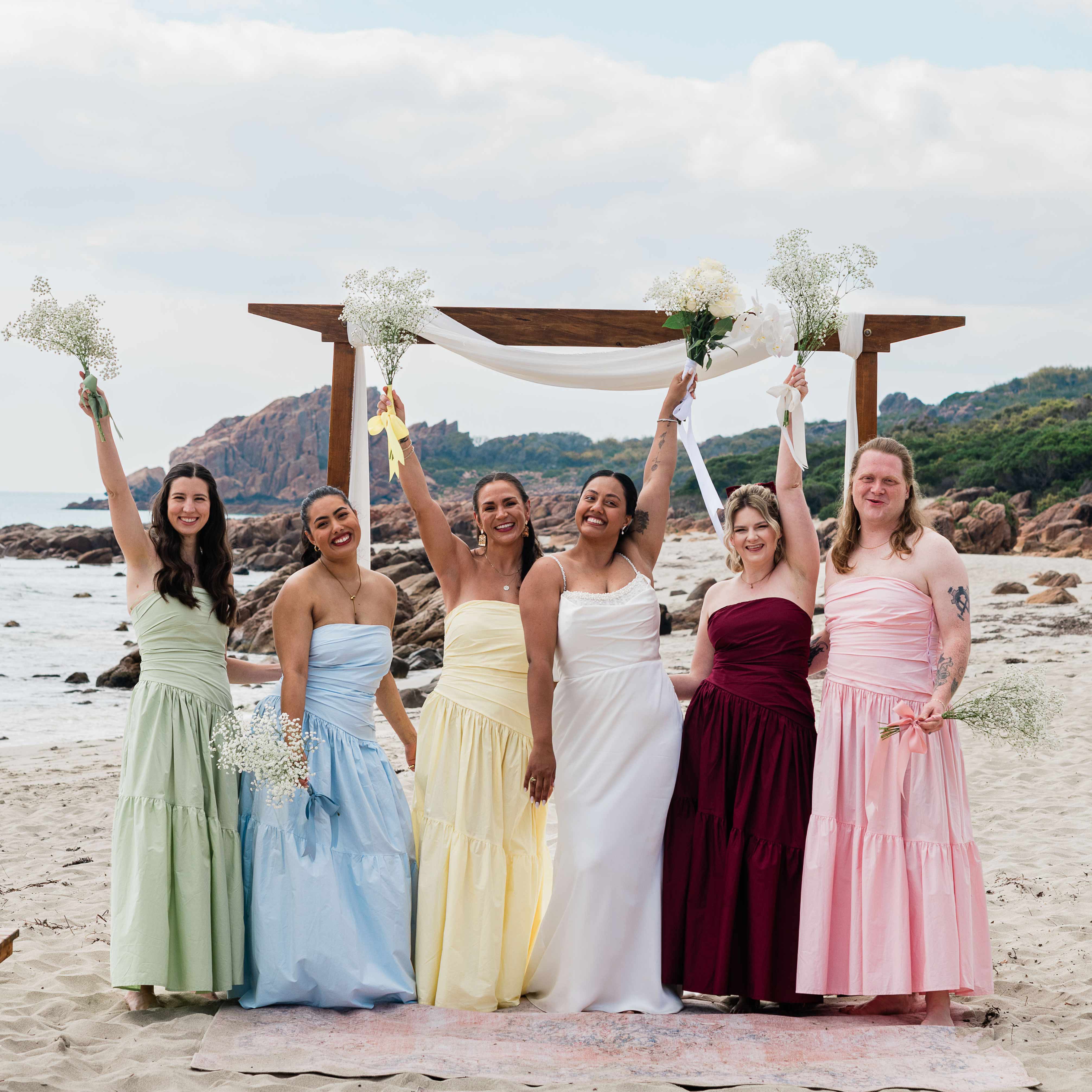
Neither is objectively better. The right answer depends on the season and the couple. If you’re leaning coastal, my Margaret River beach wedding guide runs through every ceremony beach in detail.
In summer (December to February), forest ceremonies are the smarter choice.
The south-westerly sea breeze typically hits the coast from midday onward and does not ease until evening. By 2pm on an exposed beach, guests are holding down hats and squinting. The forest is sheltered, shaded, and 5 to 8 degrees cooler than the coast on a hot day. Beach portraits can be scheduled after 4:30pm at sheltered locations when the wind drops.
In autumn (March to May), both work beautifully. The weather stabilises, the light goes golden, and clifftop ceremonies at Sugarloaf or Hamelin Bay are as good as they get anywhere in Australia. April is the peak booking month in the region for good reason.
In winter (June to August), overcast skies produce even, flattering light for photography without hard shadows or squinting. The forest positively glows after rain, with the karri bark taking on a deep copper tone and the undergrowth bright green. Winter ceremonies in Boranup are genuinely underrated.
In spring (September to November), the forest floor is covered in wildflowers. The light and colour are extraordinary. But afternoon showers are common and volatile, and exposed clifftops in spring carry real weather risk. Forest canopies provide natural shelter and the most reliable spring option.
What permits do you need for a micro-wedding in Margaret River?
This is the section most couples get wrong, and getting it wrong means either a fine, a forced cancellation, or a ceremony that a ranger interrupts. There are three separate permit jurisdictions in South West WA, and they each have different rules, fees, and timelines.
| Permit Authority | Locations Covered | Fee | Lead Time | Key Restrictions |
|---|---|---|---|---|
| Shire of Augusta Margaret River (SAMR) | Redgate Beach, Gnarabup Beach, municipal reserves | $156 non-refundable | 4 to 6 weeks (3 months recommended) | Max 3 hours total. One arch, 10 chairs, one celebrant table, 10sqm shade structure. No confetti of any kind, including organic petals. No ground pegging. Not issued for long weekends or peak summer. |
| City of Busselton | Bunker Bay, Meelup Beach, Yallingup, northern corridor | $96 + $65 booking fee | 4 weeks minimum | Max 2 hours. Flower petals and raw rice permitted. Alcohol requires a separate liquor consumption application. |
| DBCA (National Parks) | Boranup Forest, Hamelin Bay, Sugarloaf Rock, Canal Rocks, Leeuwin-Naturaliste National Park | $0 ceremony fee + $117 commercial operator licence | 60 days minimum, 6 months recommended | Boranup Forest: no structures of any kind. No arch, no chairs, no tables. Guests must remain on designated paths. Sugarloaf Rock: no drones. No dogs anywhere in national parks. |
Any professional operating in a national park needs a DBCA commercial operator licence, which is not optional.
Hamelin Bay is a joint jurisdiction under both SAMR and DBCA rules, which means both sets of restrictions apply simultaneously. This catches couples and vendors who only research one authority.
Beach ceremony permits in this jurisdiction come from the Shire of Augusta Margaret River.
The commercial operator licence from DBCA covers all professionals hired to work at the ceremony: the photographer, the celebrant, the florist. It is not optional. Any professional operating in a national park without it risks an on-the-spot fine. When John Rice manages the permit for a ceremony, this licence is included.
The practical advice: start the permit process the moment you have a date, not when you have everything else sorted. Six months lead time for DBCA locations is not excessive. It is what the permit system actually requires.
How do you keep 20 guests comfortable and entertained on the day?
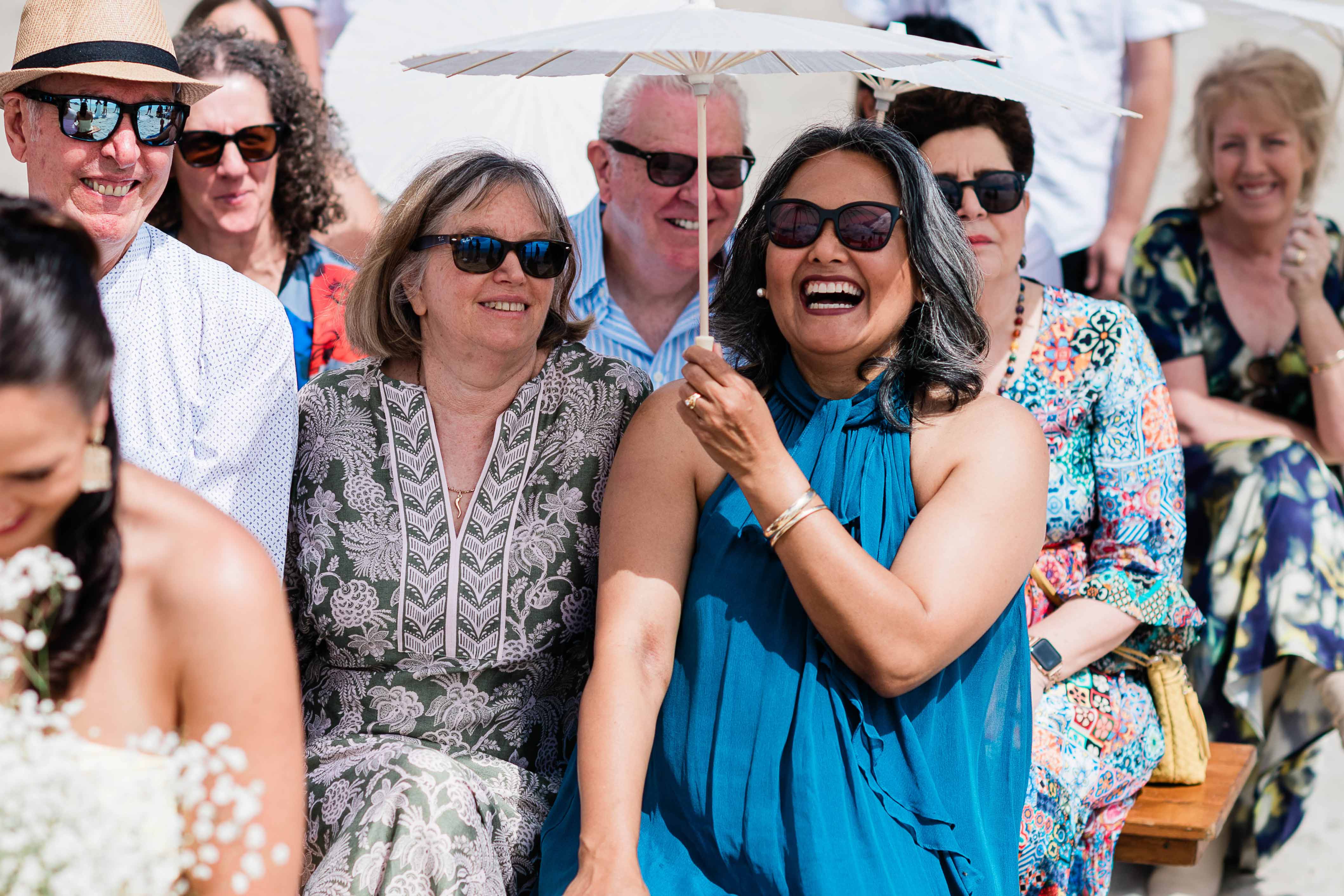
This is the question that separates a micro-wedding from a disorganised small gathering. Twenty guests still need to get somewhere, stand somewhere comfortable during the ceremony, and have something to do while you are gone for portraits. If nobody has thought about any of that, the day becomes stressful for everyone.
The solution is a fully hosted guest experience. Here is what that looks like in practice.
Guests are transported to the ceremony location. No one gets lost navigating an unmarked forest track. No one parks in the wrong spot. No one is late. Transport is arranged, timed, and managed.
At the ceremony location, guests arrive to a space that is ready. The ceremony itself is short by design: 20 to 30 minutes of genuine celebration, not performative production.
Immediately after the ceremony, a bar opens at the location. Sparkling wine, beers, and soft drinks. Guests have something in hand within two minutes of the last word of the vows. Nobody stands around wondering what to do.
While the bar is open, a forest picnic hamper is available. Guests graze, photograph each other, wander among the trees. The celebration continues without the couple needing to manage it.
John runs the family portrait list: every combination of family groupings prepared in advance, called efficiently, and done within 20 to 30 minutes. No missed combinations. No herding. Guests are released back to drinks the moment their group is done.
The couple then goes to golden hour portraits. This is the private portion of the day, often including what is called The Intermission: a quiet 20 to 30 minute window for just the two of you before the evening begins. Guests return to accommodation.
By the time the couple walks through the door after portraits, a private chef has been cooking for an hour. Dinner is ready.
What does a complete micro-wedding day timeline look like?
Every day is different, but a 20-guest micro-wedding in Margaret River typically follows this structure:
| Time | What Happens |
|---|---|
| Morning | Hair and makeup at accommodation. John coordinates arrival times with the artist. |
| Early afternoon | Guests receive transport briefing. Ceremony location prepared. |
| 3:30pm | Guest transport departs for ceremony location. |
| 4:00pm | Ceremony begins. Celebrant, florals, and guests in position. |
| 4:30pm | Ceremony concludes. Bar opens. Hamper available. |
| 4:30 to 5:30pm | Family portraits, guest celebration at ceremony location. |
| 5:30pm | Guests return to accommodation via transport. Couple begins golden hour portraits. |
| 5:30 to 7:00pm | Golden hour and The Intermission: private portraits and couple time. |
| 6:30pm | Private chef arrives at accommodation. Begins cooking. |
| 7:30pm | Couple returns. Dinner begins. |
| Evening | Dinner, speeches, cake cut at the table. No venue curfew. No DJ. Just the people you chose. |
This timeline shifts by season. In summer, the ceremony moves to late afternoon (4:30 to 5:00pm start) to avoid peak heat. In winter, it moves slightly earlier because golden hour arrives before 5:30pm.
How far in advance do you need to book for a Margaret River micro-wedding?
The booking lead time depends on the season and the type of ceremony location you want.
For autumn (March to May) Saturdays, which are the most sought-after dates in the region, 12 months is not unreasonable and 6 months is the minimum. April is consistently the highest-demand month.
For DBCA locations such as Boranup Forest, the permit alone requires 60 days minimum, and the DBCA recommends 6 months for popular dates. That timeline cannot be shortened. The permit process is bureaucratic and sequential, and there are no exceptions for late applicants.
For SAMR beach locations (Redgate, Gnarabup), a 4 to 6 week permit window applies, but the ceremony cannot be permitted for long weekends or peak summer periods at all. Planning to marry on a summer long weekend at Redgate Beach is not possible under a standard permit.
For interstate couples flying from Melbourne or Sydney, Jetstar operates direct flights to Busselton Airport (BQB) three times weekly from Melbourne (Wednesday, Friday, Sunday) and twice from Sydney (Tuesday, Saturday). BQB is 51 kilometres north of Margaret River, approximately 40 minutes by road. Book flights and accommodation before finalising the date.
What is the best time of year for a micro-wedding in Margaret River?
The honest recommendation for most couples is autumn, specifically March through May. The weather settles after the volatility of summer, the afternoon sea breezes ease, and the light in late afternoon is the kind that makes photographs look like they were shot by someone who knows exactly what they are doing. Which, 300 weddings in, is the idea.
That said, every season has a strong case.
Summer works beautifully in Boranup Forest, where the canopy handles the heat and the afternoon breeze is blocked by the trees. Schedule the ceremony for 4:30pm, move beach portraits to sheltered locations after 5:00pm, and summer is excellent.
Winter in Margaret River is mild by any standard outside of tropical Australia. June, July, and August rarely drop below 8 degrees in the evening. Overcast days are the norm, and they are actually better for photography than harsh midday summer sun. Vendor availability is higher in winter and some suppliers offer off-peak pricing.
Spring brings wildflowers to the forest floor from September through November, but the weather is the least predictable of any season. If you want spring, plan for a forest ceremony with a weather contingency, and accept that a shower is possible.
How do you get 20 guests to a forest ceremony location?
This is one of the most overlooked logistics problems in micro-wedding planning, and it matters more than couples expect.
Boranup Forest has limited parking and unmarked access tracks. Without clear directions and coordination, guests arriving independently will park in different spots, miss the track entrance, or arrive at different times and interrupt the ceremony setup. One guest getting lost on a forest road changes the energy of the entire day before it starts.
The solution is group transport: a single vehicle or two that collects guests from a central point (usually the accommodation) and delivers them to the ceremony location together. John coordinates this as part of the hosted micro-wedding service. Guests are given one instruction: be ready at a specified time at a specified location. Everything else is handled.
The same applies to coastal ceremonies. Parking at Bunker Bay on a summer Saturday is competitive. Guests who drive individually will arrive stressed. Guests who arrive together, on time, with no navigation required, arrive relaxed. That is the difference between a hosted experience and a logistics problem.
What happens during golden hour portraits while guests wait?
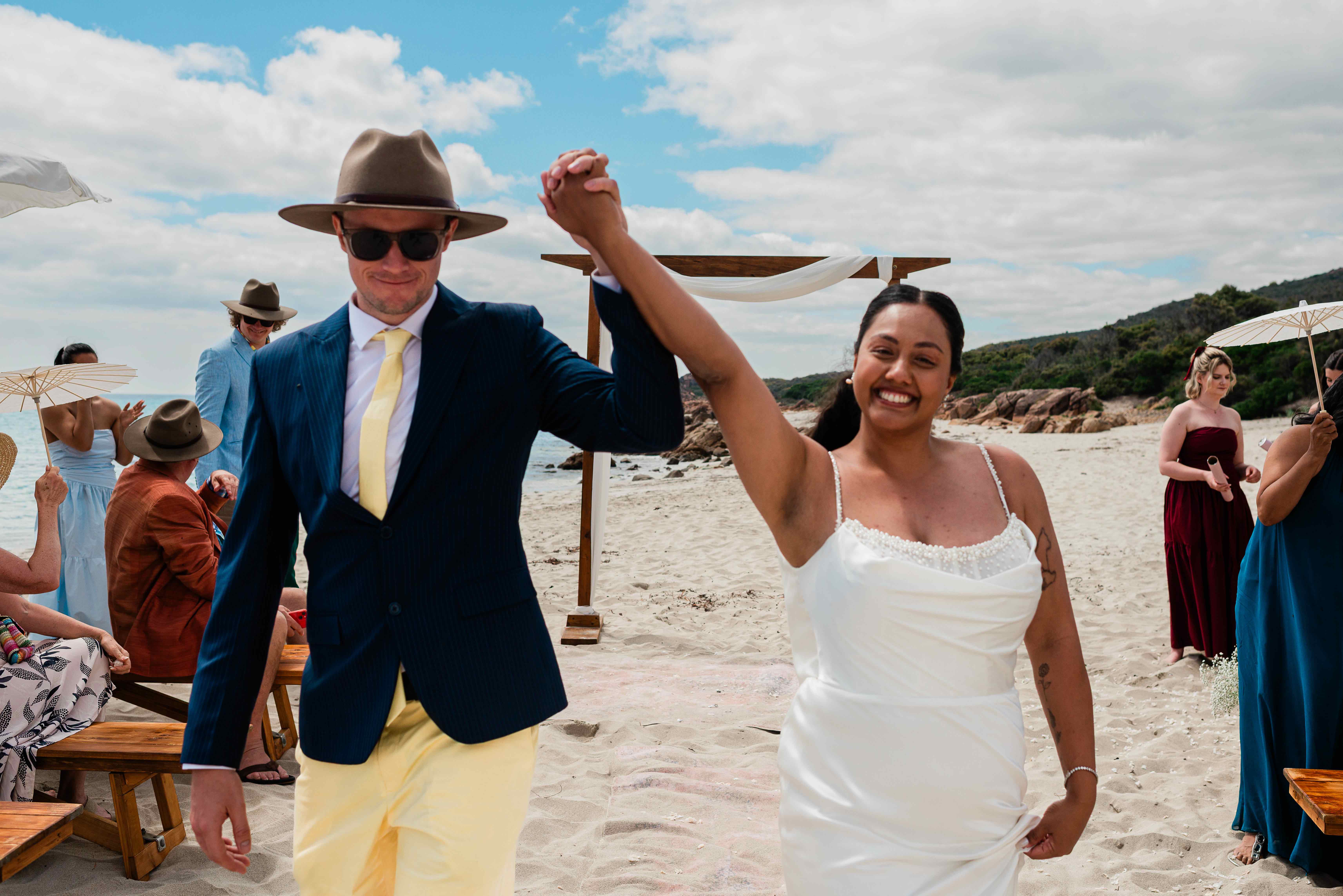
This is the question nobody in the industry answers clearly, and it is one of the most common anxieties couples express before their day.
In a traditional large wedding, guests wait during portrait time because there is nothing else happening. They stand around a cocktail area, largely ignored, for 90 minutes while the bridal party photographs in various configurations. It is the most complained-about portion of a traditional wedding.
In a hosted micro-wedding in Margaret River, the ceremony location becomes the guest celebration space for the portrait hour. The bar is open. The hamper is available. Guests who want to explore the forest can. Those who want to sit and talk do. The celebration is already underway. The couple’s absence is not a void; it is just a natural break in a day that has structure.
Before guests leave the ceremony location, John runs the family portrait list efficiently. Every combination that matters is captured. Guests are then transported back to accommodation while the couple continues into golden hour.
The Intermission is built into this window for a reason. After the ceremony, after the family photos, the couple gets 20 to 30 minutes alone in a quiet location before the evening begins. No guests. No schedule. Just the two people the whole day is actually about. It is consistently described by couples as one of the most memorable parts of the day.
How do you organise a sit-down dinner after a forest ceremony?
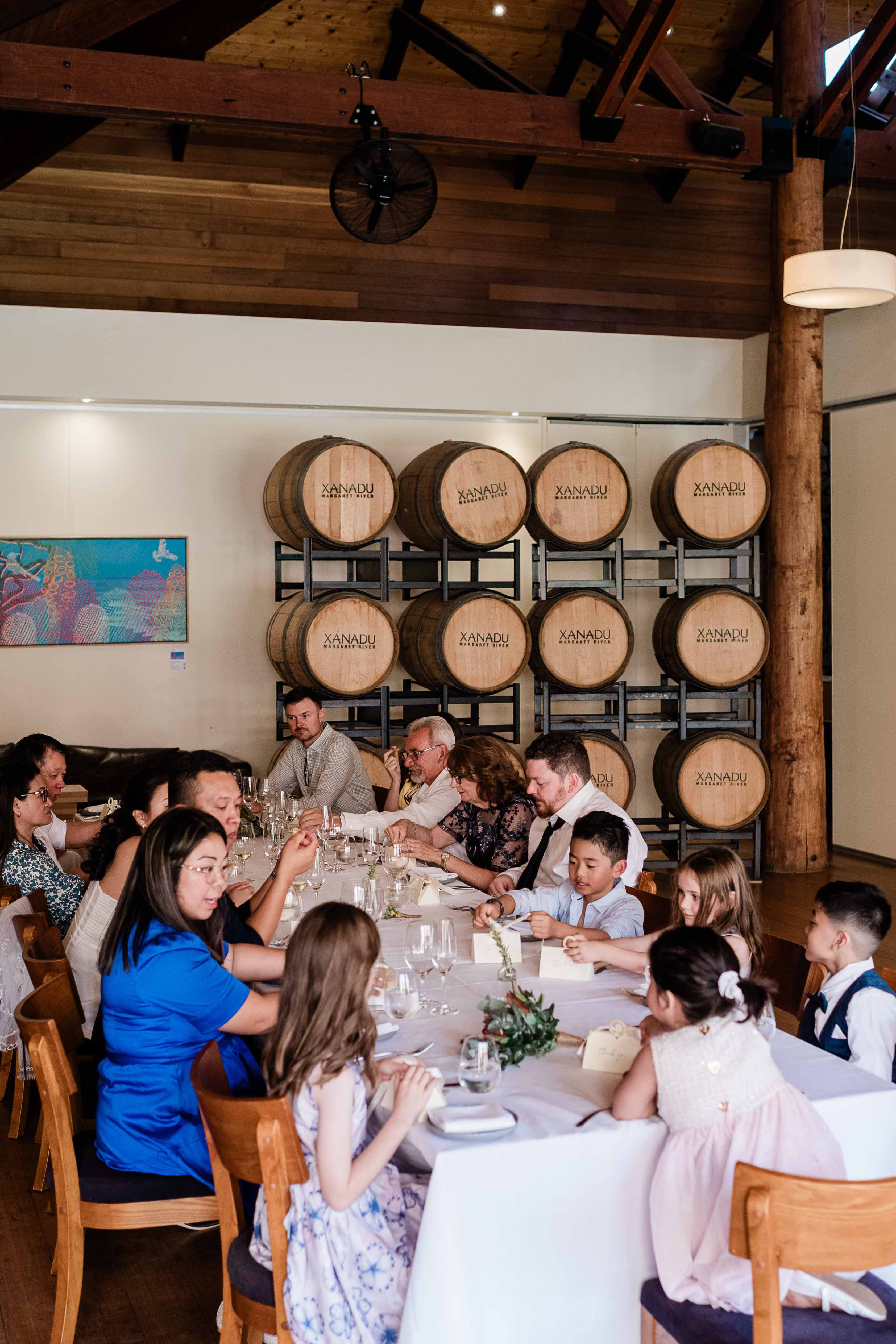
The private chef model is the cleanest solution for post-ceremony dining after a micro-wedding in Margaret River.
A private chef arrives at the accommodation while the couple is doing golden hour portraits, typically 90 to 120 minutes before dinner. By the time the couple walks through the door, the food is either ready or minutes away. Guests who returned from the ceremony location ahead of the couple have had time to freshen up. The transition from outdoor ceremony to indoor dinner is smooth rather than rushed.
The accommodation options around Margaret River and Prevelly that suit 20 guests typically have large open kitchen areas that work well for this format. The chef cooks in full view of guests during the reception, which makes the preparation itself part of the evening rather than a hidden logistical event.
Speeches, a cake cut at the table, and an evening without a venue curfew are all possible in this format. No function room. No DJ optional extras at checkout. Just a house, your 20 people, excellent food, and a view of the paddocks or the forest depending on where you are staying.
What does an all-inclusive micro-wedding package include?
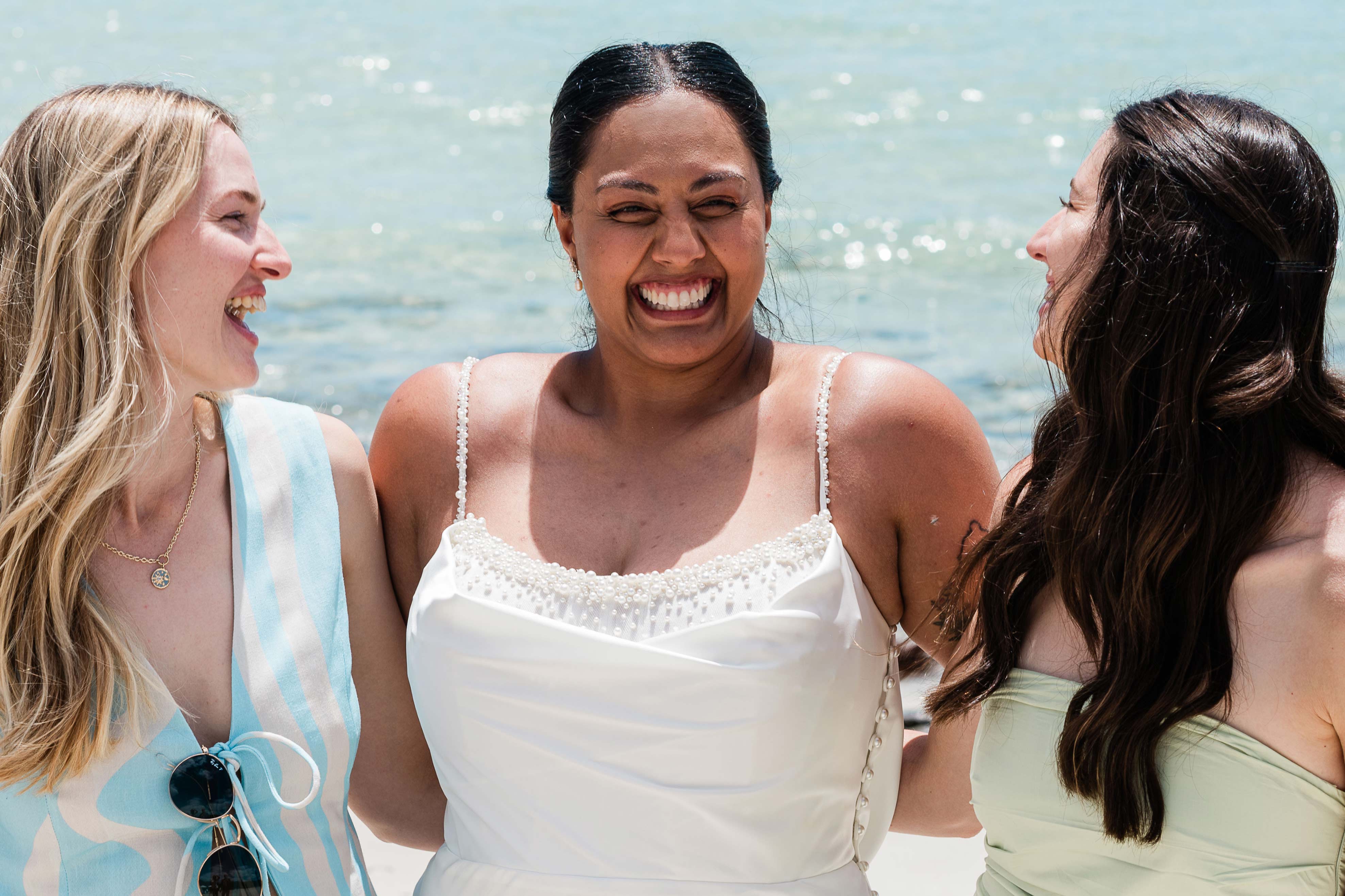
The phrase “all-inclusive” is used loosely in the wedding industry. In John Rice’s packages, it means a single payment covers every vendor and every service required to execute the day. You do not receive a list of vendors to contact. You do not coordinate separate payments to a celebrant, florist, and hair and makeup artist. You do not manage permit applications. John books, briefs, coordinates, and pays every member of the Dream Team.
What that includes as standard:
Photography by John Rice across the full day. Reportage style, with guided portraits. Camera-shy couples are specifically catered for through the way John works: unhurried, conversational, with no forced posing.
A celebrant who knows the location, has worked with John before, and understands the timeline.
A florist briefed on the style, the location, and what actually holds up in outdoor conditions in South West WA.
A hair and makeup artist scheduled to arrive at accommodation at the right time and finish with enough buffer before transport departs.
Permit management across whichever jurisdiction applies to the chosen location.
A complete day timeline distributed to every vendor and every guest.
Day-of coordination: John is the point of contact for every vendor on the day. If the florist is running late, John manages it. If the weather requires a last-minute location pivot, John makes the call and contacts every person who needs to know. The couple is informed, not consulted in a panic.
Who coordinates the vendors, permits, and timeline for a micro-wedding?
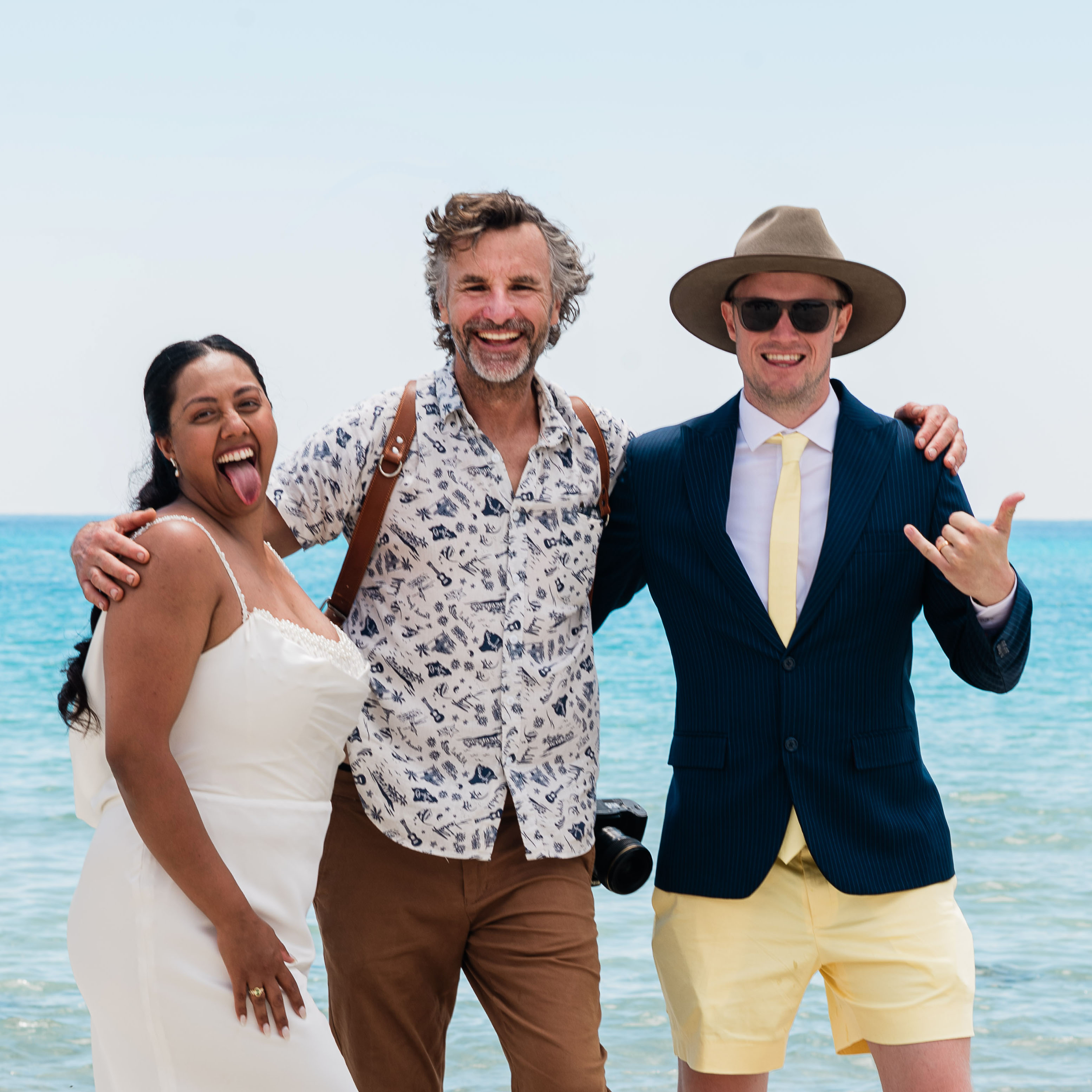
John Rice does. That is the entire model.
You have one phone number. One email address. One person who knows every vendor, every location, every permit requirement, and every weather pattern in the South West. The vendor network, called the Dream Team, is made up of suppliers John has worked with repeatedly. They know how he operates. They know what the timeline means. They arrive on time and know what to do because they have done it before.
This is different from hiring a photographer who also offers planning as an optional extra. It is different from a venue coordinator whose job ends at the gate. And it is different from using a planning checklist from a wedding website and attempting to contact, brief, and coordinate five separate vendors yourself while also planning a wedding.
One payment. You coordinate nothing. John coordinates everything.
“John made us feel so at ease with everything in the lead up and of course on the big day. He was extremely helpful, kind, fun and responsive to any queries we had from afar.” — Claudia L, planned from Ireland
“Your organisation was what made our day. From the hair and makeup, flowers, right through to meeting you and the celebrant, you were both so genuine and chilled.” — Emily, elopement client
Real micro-wedding: forest ceremony and long-table dinner in Prevelly
A couple from Melbourne. Twenty guests, flown in from across the country. The ceremony was at Boranup Forest at 4pm in early April, which meant the light came through the karri canopy at exactly the angle that makes everything look like a painting. No arch. No chairs. Guests stood in a natural semicircle in the undergrowth while a celebrant who has done this dozens of times in that specific space read vows that were entirely theirs.
The bar opened the moment the ceremony finished. The hamper was on a rug between the roots of a tree that has been there for 300 years. Guests explored, photographed each other, and talked. The family portrait list took 25 minutes. Guests were back in the transport by 6pm.
The couple went deeper into the forest for golden hour. The Intermission: twenty minutes sitting on a log in a clearing nobody else was in, drinking a glass of something cold, with nothing required of either of them. Then back to the house in Prevelly, where a chef had been cooking for an hour.
Dinner was ready when they walked in. Long table. Candles. Twenty people who had flown across the country to be there.
That is a micro-wedding in Margaret River.
Frequently Asked Questions
How many guests can attend a micro-wedding in Margaret River?
Most Margaret River micro-weddings host between 10 and 30 guests. Permit structures across all three local jurisdictions (SAMR, City of Busselton, and DBCA) accommodate this range without requiring event permits that apply to larger gatherings. Boranup Forest has no specific guest cap for private ceremonies under DBCA rules, though the physical space and path requirements effectively suit groups of up to 30 guests comfortably.
Do I need a permit to get married in Boranup Forest?
The ceremony itself has no fee under DBCA rules. However, every professional you hire, including your photographer, celebrant, and florist, must be covered by a DBCA commercial operator licence, which costs $117 plus $7 per participant. Applications require a minimum 60-day lead time, and 6 months is recommended for popular dates. No structures are permitted in Boranup Forest: no arch, no chairs, no tables. Guests must remain on designated paths.
Can I get married on a Margaret River beach on a long weekend?
Not under a standard SAMR permit. The Shire of Augusta Margaret River does not issue ceremony permits for long weekends or during peak summer periods. If your preferred date falls on a long weekend, a DBCA or City of Busselton location may be the better option, depending on availability.
What is the Notice of Intended Marriage (NOIM) and when do I need to lodge it?
The NOIM is the legal document that must be lodged with a registered celebrant no earlier than 18 months before and no later than one month before the ceremony date. In Western Australia, the one-month minimum is a hard legal requirement with no exceptions. For interstate or international couples, the NOIM can be signed before an authorised witness in your home state or country and posted to the celebrant in Margaret River. John coordinates this with the celebrant as part of the planning process.
For the full breakdown of marriage law and permits, see my Margaret River elopement legal requirements guide.
How much does it cost to have a private chef for a 20-guest dinner in Margaret River?
Private chef costs in Margaret River typically range from $80 to $150 per head for a three to four course dinner, depending on the menu complexity and supplier. For 20 guests, expect $1,600 to $3,000 for the chef’s service, excluding produce costs. John coordinates and books the chef as part of the full package, so this is managed within the single payment rather than as a separate arrangement.
What is The Intermission?
The Intermission is a planned 20 to 30 minute private window built into the timeline of every John Rice micro-wedding, scheduled between the family portraits and the golden hour portrait session. It is time for just the two of you: no guests, no vendors, no schedule. A moment in a quiet location in the forest or on the coast, often with a drink and no particular agenda, before the evening begins. It is consistently described by couples as one of the most memorable parts of the day.
Can I plan a Margaret River micro-wedding from interstate or overseas?
Yes, and John specialises in this. Most couples planning a destination micro-wedding in Margaret River from Melbourne, Sydney, or internationally do the entire planning process via video call and email. The venue visits, permit applications, vendor briefings, and all coordination are handled by John on the ground. The couple arrives, the day runs, and they leave with photographs and a marriage certificate. No site visit required beforehand.
